
He was supposed to text me, but I saw him calling me instead:
“Evan, the offer came in.”
And?
“It’s really fcking low.”*
This was their #1 strategic potential buyer, and it was like a gut punch.
He expected $45M.
But the offer he got was for scarcely less than half that - and by the time the convertibles & prefs were paid, this founder wasn’t going to make much.
“If they came in this low, no way anyone else will do better. What did we miss?”
He shared the data room he had given all the bidders, and I took a look at the P&L they had included for DD.
In 30 seconds I knew exactly what screwed him over, and why he now had this hole to dig himself out of:
Raw financials can demolish your valuation.
Unfortunately, most founders hand investors their QBO export and wonder why the offer came in low.
I’m not joking, I have even seen business owners with $500,000,000+ in revenue make this mistake.
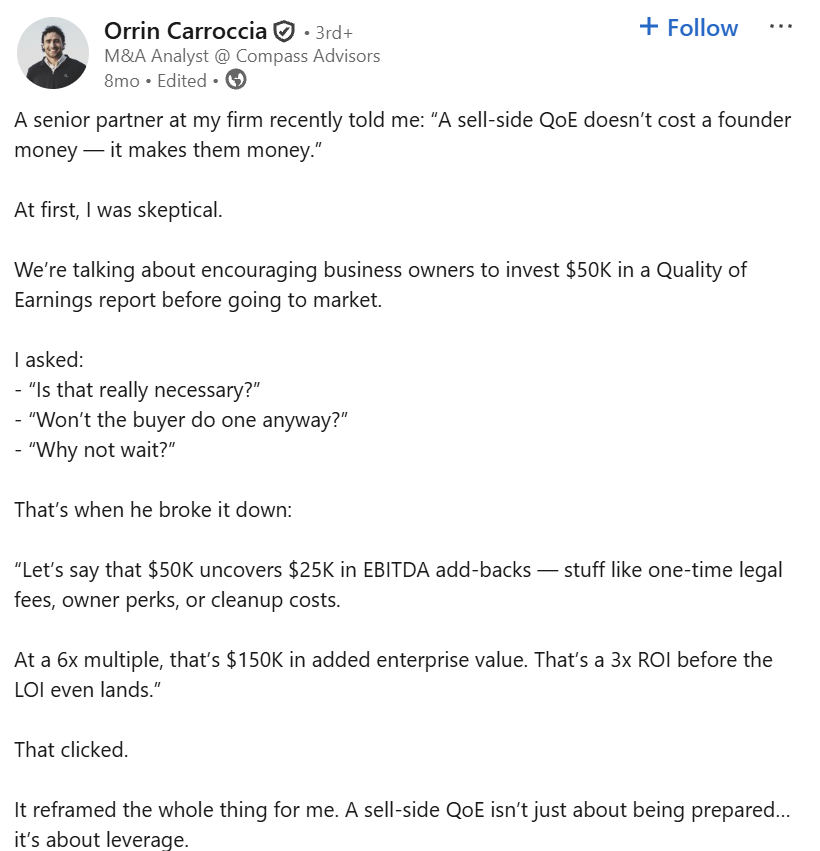
Investors & buyers don't want your bookkeeper's IRS-focused version of reality.
They want a clean picture of your actual business performance.
Why Founders Tank Their Own Valuations
The mistakes that destroy your numbers:
- One-offs: You show every random expense like it happens every month
- Discontinued ops: You include revenue from products you killed two years ago
- Non-recurring expenses: You lump one-time legal fees into operating costs
- Expensed R&D: You don't separate your pet-project R&D from your core business
"Accurate accounting" is NOT the same as "investor-ready financials."
Your CPA builds financials for the IRS. Investors need something completely different.
Let me show you how to fix this before your next pitch.
Step 1: Strip Out One-Time Expenses (And Gains)
Most founders remember to adjust expenses. They forget the gains.
One founder showed me a P&L with a massive profit spike. Turned out he sold some old equipment.
Investor response?
"So your core business actually lost money that quarter?"
Yikes.
Things you probably want to back out of your P&L:
- Legal fees from that lawsuit (unless you're sued every quarter)
- Office relocation costs
- Severance payments
- Equipment sales or asset disposals
- Tax refunds or rebates
- Insurance claim payouts
Create a line item called "Adjusted EBITDA" or "Normalized Operating Income."
Show the math. Don't hide it.
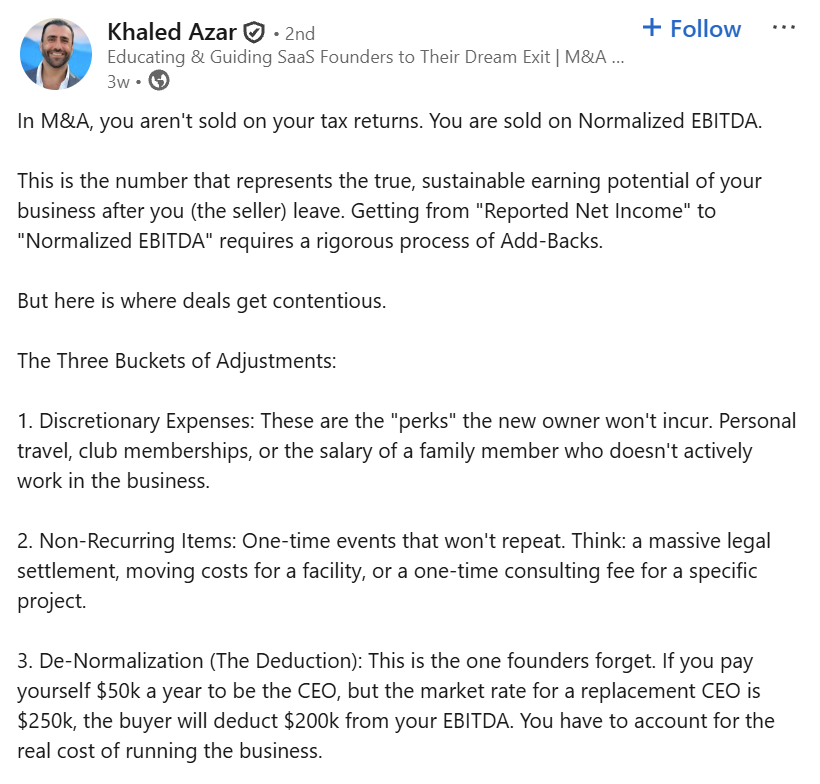
A founder I worked with had over $10 million in discontinued operations, one-time legal fees, and restructuring expenses buried in his operating overheads. We tabulated & backed them out, and his EBITDA got a two-digit bump.
The valuation jumped by tens of millions.
Step 2: Kill What's Already Dead
You shut down your enterprise product line 18 months ago.
Why is it still dragging down your margins in the P&L you're showing investors?
Discontinued activities poison your metrics:
- Revenue from products you no longer sell
- Costs from teams you already fired
- Marketing spend on channels you abandoned
- Support costs for legacy customers you're phasing out
If it's not part of your go-forward business, it shouldn't be in your go-forward financials.
Create a "Continuing Operations" section. Put the dead stuff below the line.
One SaaS founder was showing 25% gross margins. Problem? Half his revenue came from a legacy product he'd already sunset.
We pulled it out & recast. Now his core product showed 75% margins (the whole reason they relaunched the product).
Valuation went up. Significantly.
Step 3: Separate Your Side Hustles
Your main business is a SaaS platform. But you also do integration. And resell a partner's product.
Cool. Don't mix them in your investor financials.
You need to show revenue lines independently.
Non-core activities muddy everything:
- Consulting revenue looks lumpy and unpredictable (especially if it’s a bridge to core recurring revenue)
- Reseller margins tank your overall gross margin
- Professional services revenue makes you look like a services company, not a product company
Investors value SaaS at 8-12x revenue. They value services at 1-2x revenue… for good reason.
Guess what happens when you blend them together?
Break out your revenue and costs by business line. Show investors your core product metrics separately.
A founder was showing $2M in revenue with 45% margins. Looked like a struggling services company.
We split it out. His SaaS product was $1.5M at 80% margins. The consulting was $500K at negative margins (he was using it to land SaaS customers).
Suddenly his business model made sense, and investors actually got interested.
--
What you need to burn into your brain: Investors don't value your accounting. They value your business model.
Raw financials hide your true performance under a pile of noise.
Back out one-time items. Remove dead products. Separate non-core activities.
Do this before you pitch, and watch investors suddenly see what you've been building all along.
That's when the real offers start coming in.
There are 4 ways I can help you:
02. Deep-dive Digital Courses for Founders — Courses teaching you to use AI to leverage your business, win more customers & grow your business faster.
03. 1-on-1 Business Owner Coaching — Build your stack. Find your best customers. Win them. Grow your business.
04. Promote Your Business to 5K+ Weekly Readers — Want to grow your audience, subscribers, or customer base? Showcase your brand inside of my newsletter.

